
 En
En  Fa
Fa 

Key Takeaways:
Indonesia’s halal sector contributed roughly IDR 1,102 trillion (about USD 70 billion) to the economy, marking a shift from viewing the country of more than 270 million people primarily as a passive consumer market to treating it as an active standard-setter in the global Islamic economy.
Through mandatory halal certification enforced by the Halal Product Assurance Organizing Agency (BPJPH) and Mutual Recognition Agreements with foreign bodies, Jakarta is converting its market size into regulatory leverage akin to a “Brussels Effect,” requiring multinational firms to re-engineer supply chains and traceability to access Southeast Asia’s largest economy.
This regulatory diplomacy functions as a non-tariff measure that strengthens Indonesia’s position in trade talks across ASEAN, the OIC and the Global South, encourages local downstream processing and investment, and positions the country to shape global halal value chains rather than simply absorb them, despite transitional costs for exporters.
For decades, international economic analysts and multinational corporations viewed Indonesia through a singularly predictable lens: a vast, passive consumer market. Driven by a population exceeding 270 million—the vast majority of whom are Muslim—the archipelago was treated primarily as a lucrative destination for global exports across food manufacturing, pharmaceuticals, personal care, and agriculture.
However, recent economic disclosures from Jakarta signal a fundamental paradigm shift in the geopolitics of the global Islamic economy. According to official data from the Ministry of Industry, Indonesia’s halal sector contributed a staggering IDR 1,102 trillion (approximately USD 70 billion) to the national economy, anchored by rapid expansion in domestic value-added processing and industrial manufacturing.
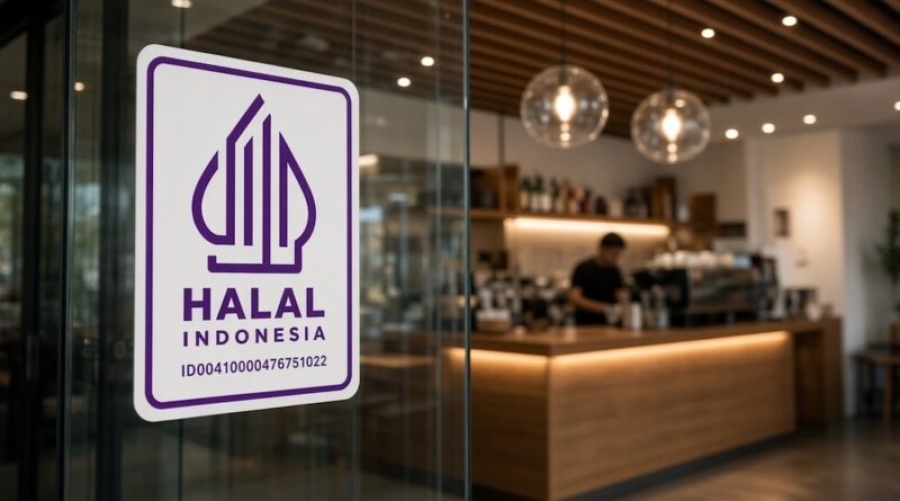
Crucially, this landmark financial metric is not merely a domestic statistical victory; it marks a strategic inflection point in regional trade architecture. Jakarta is actively leveraging its immense domestic market scale to transition from a passive consumer hub into an active global rule-maker. By enforcing comprehensive mandatory halal compliance through the Halal Product Assurance Organizing Agency (BPJPH) and pairing it with targeted industrial policy, Indonesia is executing a sophisticated model of regulatory diplomacy. In doing so, it is forcing multinational firms and foreign governments to recalibrate their global supply chain architectures to align with Jakarta’s standards.
The Paradigm Shift: From Consumer Hub to Standard Setter
Historically, the global halal economy—now valued at over USD 2 trillion—presented a striking structural paradox. The primary trade routes and export volumes were overwhelmingly controlled by non-Muslim producing nations, including Brazil, Australia, the United States, and China, supplying bulk commodities and raw proteins. Meanwhile, regulatory standards and international accreditation benchmarks were pioneered by smaller, nimble regional neighbors like Malaysia through established institutional frameworks such as JAKIM. For years, Indonesia absorbed more halal goods than anyone else, yet held remarkably little say in how global standards were set, accredited, or managed across international supply chains.
That passive dynamic has come to an abrupt end. Under Indonesia’s sweeping regulatory overhaul, mandatory halal certification is no longer framed merely as a religious option for local merchants; it is an imperative condition for market entry. Global Fast-Moving Consumer Goods (FMCG) conglomerates, pharmaceutical giants, and chemical suppliers operating out of North America, Europe, and East Asia now face a stark reality: to access Southeast Asia’s largest economy, they must re-engineer their international production lines, raw material sourcing, and logistics tracing to satisfy Jakarta’s rigorous compliance parameters.
In effect, Indonesia is operationalizing a phenomenon akin to political economy’s “Brussels Effect”—converting sheer market size into external regulatory power. Foreign manufacturers cannot afford to abandon or bypass a market of 270 million consumers; thus, complying with Indonesian standards becomes a global operational necessity rather than a localized cost.
Regulatory Diplomacy and Trade Architecture
This domestic policy pivot carries profound implications for international trade diplomacy. Rather than treating halal assurance as a routine domestic administrative hurdle, Jakarta is systematically deploying it as a potent instrument of “regulatory diplomacy.” Through Mutual Recognition Agreements (MRAs) signed between BPJPH and foreign certification bodies across Europe, the Americas, and Asia, Indonesia is binding international trade partners into its institutional orbit.
Foreign governments seeking to safeguard their export volumes to Indonesia are now forced to ensure that their domestic certification agencies comply with BPJPH’s strict operational, audit, and traceability guidelines. In practice, this alignment transforms halal certification into a potent Non-Tariff Measure (NTM). Against today’s backdrop of growing protectionism, fragmented supply lines, and realigned trade blocs, the mandatory mandate gives Jakarta genuine leverage in trade talks—especially across ASEAN, the OIC, and emerging markets in the Global South.
Furthermore, this regulatory posture acts as an implicit catalyst for industrial downstreaming (hilirisasi). Because the rules demand end-to-end traceability from origin to store shelves, global firms are increasingly pushed to invest in local processing plants, joint ventures, and dedicated logistics facilities inside Indonesia’s specialized industrial zones. The goal is straightforward: move beyond importing finished products and capture the lucrative manufacturing side of the equation.
Geopolitical Implications for Global Value Chains
This shift lands during a period of deep uncertainty for global trade. With geopolitical friction and maritime bottlenecks pushing countries toward more dependable partners, Indonesia presents a streamlined, tech-integrated compliance ecosystem. Digitizing certification and linking it directly to local logistics allows Jakarta to anchor itself firmly at the center of the global halal market.
Still, this firmer approach isn’t friction-free. Overseas exporters often point to steep initial setup costs, intricate audits, and tight implementation deadlines. At the same time, regional neighbors are carefully watching how Jakarta’s strict stance could reshape trade dynamics under the Regional Comprehensive Economic Partnership (RCEP). Yet, the sheer scale of Indonesia’s internal market provides Jakarta with the strategic buffer and political confidence to maintain its trajectory.
Indonesia’s trillion-rupiah halal milestone encapsulates a mature, forward-looking doctrine of economic statecraft. By turning its huge domestic footprint into actual international leverage, Jakarta shows how rising middle powers can shape global trade rules rather than simply accepting them.
As this regulatory push deepens, global business players will have little choice but to adapt to the new landscape. The underlying message from Jakarta is unambiguous: access to the world’s premier Muslim consumer market now requires total alignment with its standards. Indonesia is no longer merely participating in the global market—it is dictating how that market operates